Trailer Breakdowns Cost More Than the Repair
A trailer with a brake fault, a blown light, or a jammed door does not just need fixing - it means a load that is not moving, a driver waiting, and a delivery window slipping. Trailer problems are often treated as secondary to the tractor, but a trailer sitting at a shop or on the shoulder costs your operation the same way an engine failure does. We treat trailer repair with the same urgency as engine work.
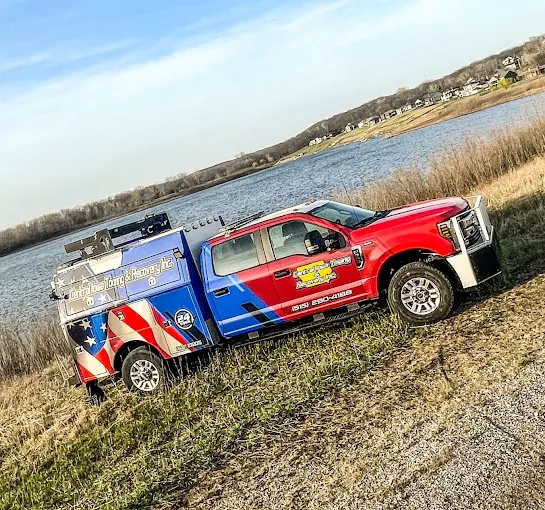
Call (515) 450-0366. Our mobile technicians carry parts and tools for common trailer brake, lighting, and electrical issues. If the repair needs shop equipment, Central Iowa Towing and Recovery handles the tow to our Ames facility.
Trailer Brake Systems: The Most Overlooked Wear Point
Trailer brakes do more of the stopping work on a loaded combination than most owners realize, and trailers frequently change tractors, which means brake condition may not get inspected between annual DOT checks the way a dedicated tractor's brakes would. This makes trailer brakes one of the most common sources of DOT violations we see - not because the components are inherently unreliable, but because they get less routine attention than the tractor they are hooked to.
We inspect and service trailer brake shoes, drums, automatic slack adjusters, air chambers, and ABS components (on trailers so equipped). A trailer that runs daily with a different tractor each week benefits from more frequent brake checks than the annual minimum, especially for fleets running heavy loads through Central Iowa's mix of interstate and secondary roads.
Axle and Suspension
Trailer axles and suspension systems - whether spring, air ride, or a combination - take a beating from loaded miles and Iowa road conditions. We service axle alignment, suspension bushings and air bags, and wheel-end components including bearings and seals. Uneven tire wear on a trailer is often the first visible sign of an axle or suspension issue worth catching before it becomes a bigger repair or a roadside failure.
Lighting, Electrical, and DOT Compliance
Trailer lighting - marker lights, clearance lights, brake lights, and turn signals - is one of the most cited DOT violation categories, often from damaged wiring at the pigtail connection or corroded grounds rather than a failed bulb. We diagnose the actual electrical fault rather than replacing bulbs one at a time. Trailers require their own annual DOT inspection independent of the tractor, and we perform full trailer inspections with same-visit violation repair.
Doors and Landing Gear
Roll-up and swing door repair covers track alignment, hardware replacement, and seal service to keep cargo dry and secure. Landing gear repair covers the crank mechanism, leg assemblies, and mounting points that take repeated stress from coupling and uncoupling cycles - a wear pattern that is heavier on trailers changing tractors frequently, like warehouse and distribution operations across Central Iowa.
A landing gear that cranks hard or binds partway is rarely a problem with the crank handle itself. More often it is a worn gearbox, a bent leg from a hard-set on uneven ground, or dried-out grease in the drive tube. Left alone, a binding landing gear becomes a safety issue: a driver forcing a stuck crank under load is a common source of hand and back injuries in yards across Iowa. We service the full mechanism, not just the visible hardware.
Iowa Weather and Trailer Wear
Trailers take a different kind of weather damage than tractors because they sit exposed to the elements between loads, often for longer stretches. Winter road salt accelerates corrosion on brake components, electrical connectors, and frame rails, particularly on trailers that see regular use on treated Iowa highways through December, January, and February. We see corroded ABS connectors and pitted brake chambers on trailers well before the rest of the fleet shows similar wear, simply because the trailer sat lower to the road spray and salt exposure than the tractor pulling it.
Summer heat affects trailer tires and suspension bushings differently than winter cold. Extended time on hot pavement accelerates tire sidewall aging, and rubber suspension bushings and air bags degrade faster under sustained heat cycling. A trailer that sits loaded in a yard through a Central Iowa summer, then runs a long highway haul, is more likely to show a tire or suspension failure than one in steady rotation. We check tire condition and suspension component wear as a standard part of any trailer service, not just when something has already failed.
Trailers that sit for extended periods between hauls are more prone to brake seizure, tire flat-spotting, and battery drain on equipped units. If a trailer has been parked for more than a few weeks, a pre-trip check before it goes back into rotation catches these issues before they become a roadside problem. Call (515) 450-0366 to schedule a pre-service inspection.
Grain Trailer Service: A Central Iowa Specialty
Grain trailers see a different wear pattern than dry van or flatbed equipment because of the loading and unloading cycle unique to agricultural hauling. Hopper doors, tarp systems, and the hoist or hydraulic dump mechanisms on end-dump grain trailers all take direct mechanical stress every time a load cycles through a field, an elevator, or a rail loading point. During harvest season - roughly August through November in central Iowa - grain trailers can cycle several times per day, multiplying the wear rate compared to over-the-road equipment.
We service hopper door mechanisms, tarp system hardware, hoist hydraulics on end-dump trailers, and the axle and suspension systems that take repeated loaded-to-empty weight transitions throughout a harvest day. Because harvest season is time-critical for our agricultural customers, we prioritize grain trailer repairs during August through November to minimize the time a trailer sits out of the rotation during the busiest window of the year.
Reefer Trailer Chassis and Electrical Service
Refrigerated trailers add a layer of complexity beyond a standard dry van because the refrigeration unit depends on the trailer's electrical system and mechanical mounting points functioning correctly. We service the trailer chassis, brake system, suspension, and the electrical wiring that feeds the reefer unit, including battery charging circuits and wiring harnesses that run the length of the trailer. Corrosion at electrical connections is a common failure point on reefer trailers specifically, since the refrigeration system draws continuous power even when the trailer is parked, and connection points near the nose of the trailer see more exposure to road spray and weather than a standard dry van's wiring.
For refrigeration unit-specific issues - compressor faults, thermostat calibration, refrigerant system diagnostics - we coordinate with reefer unit specialists as needed, while handling the trailer chassis, brakes, and general electrical system ourselves.
Call (515) 450-0366 or schedule online. Brakes, axles, electrical, doors, DOT inspections - one shop, one call.