Iowa's Freight Capital: Why Des Moines Trucks Need a Diesel Specialist
Des Moines sits at the intersection of I-35 and I-80 - two of the highest-volume commercial freight corridors in the central United States. Add I-235 cutting through the metro, and you have a convergence point where north-south traffic from Minnesota to Missouri meets east-west traffic from Omaha to the Quad Cities. Polk County processes more commercial truck traffic than any other county in Iowa, and that traffic creates diesel service demand that general auto shops are not equipped to handle.
Our shop is at 2019 E Lincoln Way in Ames, approximately 45 minutes north of downtown Des Moines on I-35. For in-shop repairs, Des Moines trucks come to us on a straight shot up the interstate - no metro traffic, no navigating surface streets. For mobile service and emergency breakdowns, we dispatch to Des Moines and the full metro 24 hours a day. If your truck is sitting on the shoulder of I-35 south of Ankeny or broken down at a loading dock in the East Side industrial district, we come to you.
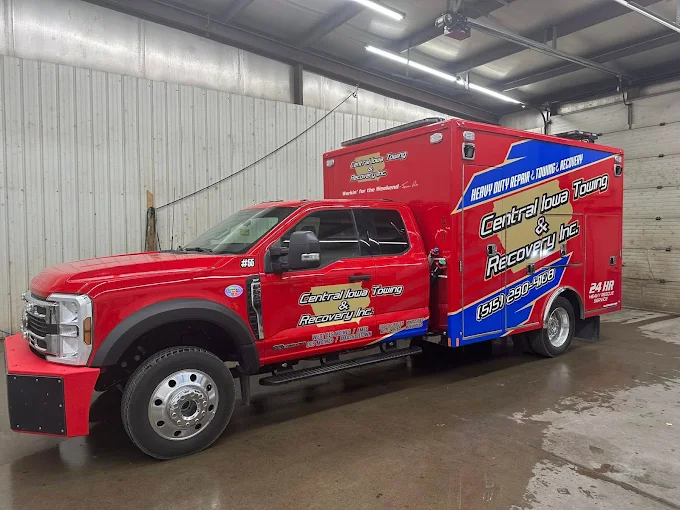
Call (515) 450-0366 immediately. Give us your location, mile marker if you are on the highway, and your truck's engine type. We dispatch a mobile tech with CAT ET, Cummins Insite, and Detroit DiagnosticLink. Response to most Des Moines metro locations is 45 to 60 minutes. If the truck needs a tow, Central Iowa Towing and Recovery - our parent company - handles it. One call covers everything.
Des Moines Metro: Three Types of Operations, Three Sets of Diesel Problems
Distribution and logistics operations. The Des Moines metro has become one of the Midwest's significant distribution hubs. The I-80/I-35 interchange provides access to the full east-west and north-south interstate network, which has drawn warehouse and distribution center development across the metro - from Ankeny's I-35 corridor to Altoona's I-80 frontage to the industrial areas south of downtown. These operations run Freightliner Cascadias, Kenworth T680s, and Peterbilt 579s on tight schedules. The operating pattern is demanding: dock loading with extended idle, city delivery with constant braking and acceleration, then highway repositioning back to the warehouse. That cycle creates DPF loading problems because the trucks never sustain highway exhaust temperatures long enough for passive regeneration. It also accelerates brake wear because the tractor is hauling a loaded trailer through metro traffic all day.
Long-haul carriers staging through Polk County. Des Moines is a natural staging point for carriers running the I-80 corridor. Trucks that have been operating for 500 to 1,000 miles across multiple states pull into the Des Moines metro for fuel, rest, or load transfers. These trucks surface problems that have been building for days - an injector that has been throwing intermittent fault codes since Nebraska, a turbo boost leak that the driver has been compensating for since Illinois, a DPF that loaded up in stop-and-go traffic in Omaha and has been running in active regen mode ever since. When these trucks stop in Des Moines and the problem becomes critical, the driver needs a diesel specialist who can diagnose accurately and repair quickly - not a general shop that wants to keep the truck for three days while they figure out the engine platform.
Construction and municipal fleets. Polk County's construction activity runs year-round except during the deepest winter freeze. Road construction on I-235, commercial building development across the metro, residential expansion in the western suburbs, and the constant infrastructure maintenance that a metro area of 700,000 people requires all run on diesel. These fleets tend to run a mix of Class 6 through Class 8 vehicles - medium-duty trucks, service vehicles with utility bodies, concrete pumpers, and heavy haul equipment. The diesel engines in these applications face unique stress: lots of idle time on job sites, frequent PTO operation that loads the engine differently than highway driving, and dust exposure that accelerates air filter clogging and can contaminate the intake system.
If you run a distribution fleet, construction operation, or any commercial vehicle operation in the Des Moines metro, call (515) 450-0366 to set up a fleet account. Priority scheduling means your trucks do not wait behind walk-in work when something goes down. No contracts, no minimums - we earn it every month.
Why Des Moines Truckers Drive to Our Ames Shop
Des Moines has general automotive shops. It has dealership service departments that occasionally work on commercial trucks. But Des Moines does not have many shops that work exclusively on Class 6, 7, and 8 heavy-duty diesel vehicles using manufacturer-level diagnostic software on every service call. That is what we are.
The 45-minute drive from Des Moines to our Ames shop on I-35 is a straight shot with no metro congestion. Many of our Des Moines customers prefer the in-shop experience over mobile service for non-emergency work because our Ames facility has the lifts, the tooling, and the parts inventory that mobile service trucks cannot carry. For a major engine repair, a transmission job, or a thorough DOT inspection with violation repair, coming to the shop gives us the full capability to do the work right.
We run CAT Electronic Technician, Cummins Insite, and Detroit DiagnosticLink on every service call - the same software platforms the engine dealers use. That diagnostic depth is the difference between a shop that reads a fault code and replaces the component the code points to, and a shop that uses the diagnostic data to find the actual root cause before recommending any repair. When a DD15 in a 2020 Freightliner throws a turbo underboost code, we check the VGT actuator duty cycle, the boost pressure sensor accuracy, the charge air cooler piping for leaks, and the EGR system for excessive flow before we touch the turbocharger. That process saves Des Moines truckers money and prevents the comeback repairs that plague shops that diagnose by parts replacement.
If your truck has been to another shop and the problem came back, or you are being quoted for expensive component replacements without a clear explanation of the diagnosis, bring it to us. We will run the manufacturer-level diagnostics, explain what we find, and give you a written quote before we start any work. Call (515) 450-0366 or schedule online.
I-35 and I-80 Breakdown Response: Des Moines Metro Coverage
Mobile response to Des Moines from our Ames base is typically 45 to 60 minutes under normal conditions. I-35 between Ames and the north side of Des Moines is a direct 40-minute drive. The I-80/I-35 interchange area, the East Village industrial zone, the SE 14th Street corridor, and the Ankeny-to-downtown stretch are all within our standard response window.
For breakdowns on I-80 through the Des Moines metro - from the West Des Moines interchange east through Altoona and beyond - we dispatch directly. Give us your mile marker and direction of travel when you call. For breakdowns on I-235 inside the metro, give us the nearest exit or cross street.
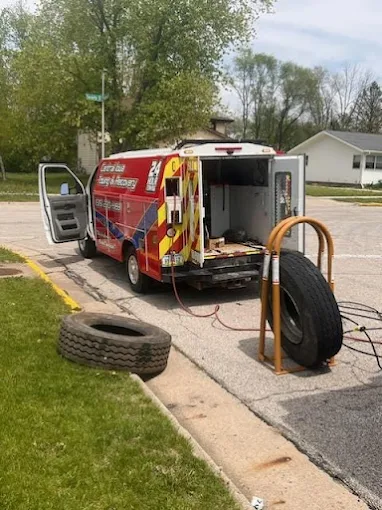
Our mobile service trucks carry CAT ET, Cummins Insite, and Detroit DiagnosticLink - the same diagnostic platforms we use in our Ames shop. They also carry a stock of commonly needed parts: fuel filters, water separators, DEF sensors, air dryer cartridges, and injector components for CAT, Cummins, and Detroit engines. The goal is to diagnose and repair on-site whenever possible. When the repair requires shop equipment - a lift, a press, specialized tooling - Central Iowa Towing and Recovery handles transport to our Ames facility. One phone call handles diagnosis, repair, and tow if needed.
Stranded on I-35 or I-80 near Des Moines? Call (515) 450-0366 now. Do not wait until business hours. We dispatch 24/7, every day of the year.
Des Moines Winter Diesel Problems: Worse Than the Rest of Iowa
Des Moines winters are harder on diesel engines than the surrounding rural areas, and not just because of the cold. The metro's traffic density creates operating patterns that compound cold-weather diesel issues in ways that rural highway operations do not experience.
DPF loading is accelerated by metro stop-and-go. A truck running I-35 from Kansas City to Minneapolis at highway speed maintains exhaust temperatures high enough for passive DPF regeneration most of the time. A truck making deliveries across the Des Moines metro - loading dock to loading dock, surface street to surface street, idle to accelerate to brake to idle - never reaches those temperatures. In sub-zero winter weather, it is even worse. The DPF loads with soot, the truck triggers active regeneration, the driver pulls into the next delivery stop and shuts down, the regen is interrupted, and the cycle repeats until the truck derates. We see this pattern from Des Moines distribution fleets more than from any other operation in our coverage area.
Air dryer freeze-ups hit metro fleets harder. Air brake systems depend on the air dryer to remove moisture from the compressed air supply. In sub-zero temperatures, if the air dryer cartridge is saturated or the heater element has failed, moisture freezes in the air lines and valve bodies. This can cause brake application issues - from slow release to complete loss of braking on one circuit. Metro delivery trucks running frequent stops in freezing weather cycle the brake system hundreds of times per day, which means more moisture being introduced into the air system and more opportunities for freeze-up. We check the air dryer cartridge condition, heater element function, and the entire air system for moisture contamination as part of our winter prep service.
Battery and starter stress. Cold-cranking a diesel engine in negative-15-degree weather demands everything from the battery bank and starter motor. Des Moines metro trucks that start and stop multiple times per day in winter put their electrical systems under more cold-crank cycles than a long-haul truck that starts once in the morning and runs all day. Weak batteries that survived all summer fail on the first cold morning. We perform battery load testing and charging system analysis as part of our seasonal prep - catching the batteries that will fail before they strand your truck at a customer's dock at 6am.
Schedule cold-weather service before the first freeze. Fuel system winterization, air dryer cartridge replacement, battery load testing, block heater verification, and coolant analysis. One service visit in October prevents emergency calls in January. Call (515) 450-0366 to schedule fleet winter prep.
Fleet Maintenance for Des Moines Metro Operations
An unplanned breakdown in Des Moines metro traffic costs more than the repair itself. There is the missed delivery window, the driver sitting idle, the tow if the truck cannot move under its own power, and the scheduling disruption across your operation. Fleet maintenance programs exist to prevent those costs - and they work, but only when the maintenance is structured around how your specific fleet actually operates in the Des Moines metro environment.
Fleet accounts at Central Iowa Fleet Solutions receive priority scheduling, volume pricing, and per-unit service records. When your truck goes down unexpectedly, fleet customers do not wait behind walk-in work. We know your trucks, their engine platforms, and their service history. That context makes emergency diagnosis faster because we can see patterns developing across multiple service visits.
On-site maintenance at your Des Moines facility is available for fleet operations where bringing trucks to our Ames shop is not practical. Oil changes, filter service, brake inspections, coolant analysis, DOT pre-trip checks, and air system service can all be performed at your location by our mobile technicians.
Ready to set up a fleet account? Call (515) 450-0366. We will build a maintenance program around your operation - your trucks, your routes, your seasonal demands. No long-term contracts. We earn your business every month by keeping your trucks moving.
DOT Inspections for Des Moines Carriers
Iowa weigh stations on I-35 and I-80 near Des Moines actively check DOT inspection status. An out-of-service order at the Mitchellville scale on I-80 or the Ames scale on I-35 means your truck does not move until violations are corrected. Common violations at Iowa stations include brake adjustment issues, lighting failures, tire condition below minimum tread depth, and air system leaks.
We perform annual DOT inspections at our Ames shop with a critical advantage for Des Moines carriers: when we find a violation, we fix it the same visit. Inspection and repair under one roof, full documentation for your compliance file, and your truck leaves with a current sticker and everything in working order.
DOT inspection coming due? Schedule it on the same trip as routine maintenance and save yourself a second visit. Call (515) 450-0366.
Truck and Trailer Service for Des Moines Operations
Beyond diesel engine repair, we handle every major system on Class 6, 7, and 8 commercial vehicles. Brake systems (air brakes, ABS, automatic slack adjusters, compressor and air dryer service), transmission work (Eaton Fuller manuals, Allison automatics), clutch replacement, suspension and steering, driveline service, electrical diagnostics, and AC repair. Trailer service includes brake systems, axle and suspension, lighting and electrical, door repair, and landing gear.
Des Moines metro delivery operations put heavy wear on brakes and trailers specifically. Trucks running loaded trailers through metro stop-and-go accumulate brake wear faster than highway operations. Trailer brakes do more of the stopping work on a loaded combination, and trailers that change tractors frequently may not get the brake service attention they need between annual inspections. If your trailers are running the Des Moines metro daily, brake system checks should be more frequent than annual.
Engine repair, brakes, transmission, trailer service, DOT inspections, fleet maintenance, and 24/7 emergency roadside. You do not need to manage four different vendors across the Des Moines metro. Call (515) 450-0366 or schedule a repair online. We are at 2019 E Lincoln Way in Ames - 45 minutes north on I-35.