Why Generic Maintenance Schedules Fail Real Fleets
Most maintenance intervals come from an owner's manual written for average operating conditions. Almost no commercial fleet actually operates under average conditions. A grain hauler running heavy seasonal loads through harvest wears differently than a warehouse delivery truck idling at loading docks all day, which wears differently than a long-haul carrier logging steady highway miles. Applying the same 25,000-mile oil change interval and the same brake inspection schedule to all three ignores the operating pattern that actually determines wear.
We build fleet maintenance programs around how your specific trucks operate. That means looking at engine hours versus mileage, PTO usage, idle time, seasonal demand spikes, and route type before setting intervals - not defaulting to whatever number is printed in the manufacturer's manual.
Call (515) 450-0366. We will look at your fleet's actual operating pattern and build a program around it. No contracts, no minimums.
Mileage vs. Engine Hours: Getting the Interval Right
A highway tractor running consistent long-haul routes is reasonably well served by mileage-based intervals, since mileage and engine hours track closely together at highway speed. But a truck running a PTO-driven crane, compressor, or pump for hours at a time accumulates engine wear that the odometer does not reflect at all. A service truck that drives 40 miles between job sites but runs a hydraulic crane for 4 hours a day is putting far more hours on the engine than the mileage suggests.
The same is true for warehouse and distribution trucks that spend significant time idling at loading docks. A truck logging 40,000 miles a year with heavy dock idle time may have accumulated as many actual engine hours as a highway truck running 70,000 miles. We track engine hours alongside mileage for fleets where this gap matters, and set service intervals based on whichever metric more accurately reflects real wear.
What a Properly Structured Program Includes
A fleet maintenance program is not just a recurring oil change reminder. It includes scheduled oil and filter changes at intervals matched to your operating conditions, brake system inspections frequent enough to catch wear before it becomes a DOT violation, coolant analysis to catch cooling system degradation before it causes overheating damage, DOT pre-trip inspection support to keep your fleet compliance-ready, and DPF monitoring for trucks running short-haul or stop-and-go patterns that accelerate soot loading.
Every service visit gets logged to a per-unit record, so we can see patterns developing across visits - an injector trending toward failure, a brake component wearing faster than expected, a recurring DPF regeneration issue. Catching these trends early is where a real maintenance program earns its value, versus a shop that only sees your truck when something has already broken.
Priority Scheduling: What It Actually Means
Fleet accounts do not wait behind walk-in work, for either routine maintenance or an emergency breakdown. When a fleet truck goes down unexpectedly, that call gets priority over a scheduled oil change for a non-fleet customer. This matters because an unplanned breakdown costs your operation far more than the repair itself - the missed load, the driver sitting idle, the schedule disruption that ripples through your dispatch for days.
Because we keep per-unit records, when a fleet account calls about a specific truck, we already know its engine platform, service history, and what to watch for. That context makes emergency diagnosis faster and more accurate than starting from zero on an unfamiliar vehicle.
On-Site Maintenance: Keeping Trucks in Your Rotation
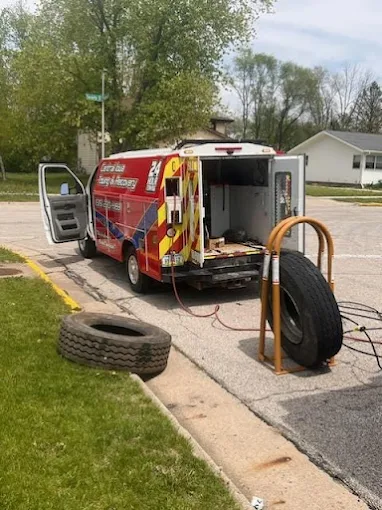
For fleets where bringing trucks to our Ames shop is not practical, our mobile technicians perform maintenance at your facility across our Central Iowa coverage area. Oil changes, filter service, brake inspections, air system checks, coolant analysis, and DOT pre-trip inspections can all happen on-site. This keeps your trucks in your dispatch rotation instead of losing a driver and a vehicle to a shop run, which matters most for warehouse and distribution operations running tight delivery windows.
Seasonal Maintenance for Iowa Operations
Central Iowa's climate swings create predictable seasonal maintenance needs that a properly structured fleet program should anticipate rather than react to. Pre-winter service in October should cover fuel system winterization, battery load testing, air dryer inspection, and coolant analysis before the first hard freeze. For agricultural fleets, pre-harvest service in July should get grain trucks and trailers ready for the heavy cycling of August through November. Building these seasonal touchpoints into your maintenance calendar prevents the emergency calls that seasonal transitions otherwise cause.
DOT Compliance as Part of Ongoing Maintenance
Fleet operators managing multiple trucks and trailers face a compliance burden that grows with fleet size. Each unit needs an annual DOT inspection, and any violation found at a roadside check can put a truck out of service until it is corrected. Building DOT compliance into your regular maintenance cycle - rather than treating inspections as a separate annual event - catches brake adjustment issues, lighting problems, and air system leaks during routine service instead of at a weigh station where an out-of-service order costs you a load and a delivery window.
For fleets with staggered inspection dates across multiple units, we track per-unit inspection status so nothing lapses unnoticed. A fleet running 15 trucks with inspections spread across the calendar needs a system that flags upcoming renewals, not a spreadsheet someone remembers to check.
The Real Cost of Reactive Maintenance
Fleets that skip structured maintenance and repair only when something breaks tend to assume they are saving money by not paying for service they do not immediately need. In practice, reactive maintenance almost always costs more over time. A neglected brake adjustment that turns into a full brake job is more expensive than the adjustment would have been. An ignored DPF regeneration issue that leads to a full derate and a roadside call costs far more than the forced regen that would have solved it weeks earlier. And every unplanned breakdown carries the hidden cost of the missed load, the idle driver, and the schedule disruption that a scheduled service visit never creates.
The fleets that get the most value from a maintenance program are not necessarily the ones spending the most on parts and labor. They are the ones whose trucks stay in service, whose drivers are not stuck on the shoulder, and whose dispatch schedule does not get disrupted by preventable failures.
Call (515) 450-0366 or schedule online. We will build a program that matches your operation, not a generic checklist.